The Structure of the German Farming Year
German agriculture distinguishes primarily between summer and winter crops — a distinction that determines not just planting date but also which harvest machinery is deployed and when seasonal labour is needed. Winter crops such as winter wheat (Winterweizen), winter barley (Wintergerste), and oilseed rape (Winterraps) are sown in autumn and harvested the following summer. Summer crops — maize, potatoes, sugar beet — are sown in spring and cleared in late summer or autumn.
Germany produces crops across roughly 12 million hectares of arable land. The northern lowlands (Norddeutsche Tiefebene) carry the heaviest concentration of large-scale arable farming, while the southern uplands mix arable cultivation with orchards, vineyards, and livestock pasture.
Month-by-Month Harvest Reference
March – April: Asparagus (White) Spring
Germany's asparagus season — the Spargelzeit — typically opens between mid-March and mid-April, depending on soil temperature. Lower Saxony, particularly around Nienburg and Braunschweig, is the country's largest white asparagus producing area. Baden-Württemberg and the Palatinate also carry significant acreage. White asparagus is harvested by hand from beneath black plastic film that blankets the ridges; the season closes by law on 24 June (Johannistag) to allow plants to recover.
Asparagus harvest is among the most labour-intensive in German agriculture. Because mechanical harvesting damages the fragile spears, hand-cutting remains standard practice. Each harvester works a set of ridges daily, cutting each spear individually below ground level.
May – June: Strawberries & Early Vegetables Spring
Strawberry picking begins in late May across warmer valleys and extends through June into early July in cooler upland areas. North Rhine-Westphalia (Kreis Kleve, Kreis Coesfeld) and the Rhine-Neckar region account for a large share of commercial strawberry cultivation. Much of the production is sold direct from farms as Selbstpflücke (pick-your-own), alongside wholesale supply to supermarkets.
Early vegetables — radishes, spring cabbage, early potatoes — come off fields in southern Germany from May onwards, with harvest shifting northward as the season progresses.
June – July: Winter Barley & Oilseed Rape Summer
Winter barley is typically the first cereal to reach maturity, with harvest beginning in late June in southern states and progressing northward through early July. Oilseed rape follows closely, cut at a point when the pods are just short of fully dry to limit shattering losses. Rape fields turn a vivid yellow in April when in flower, but by late June the crop has dried to a brown-grey and is ready for the combine.
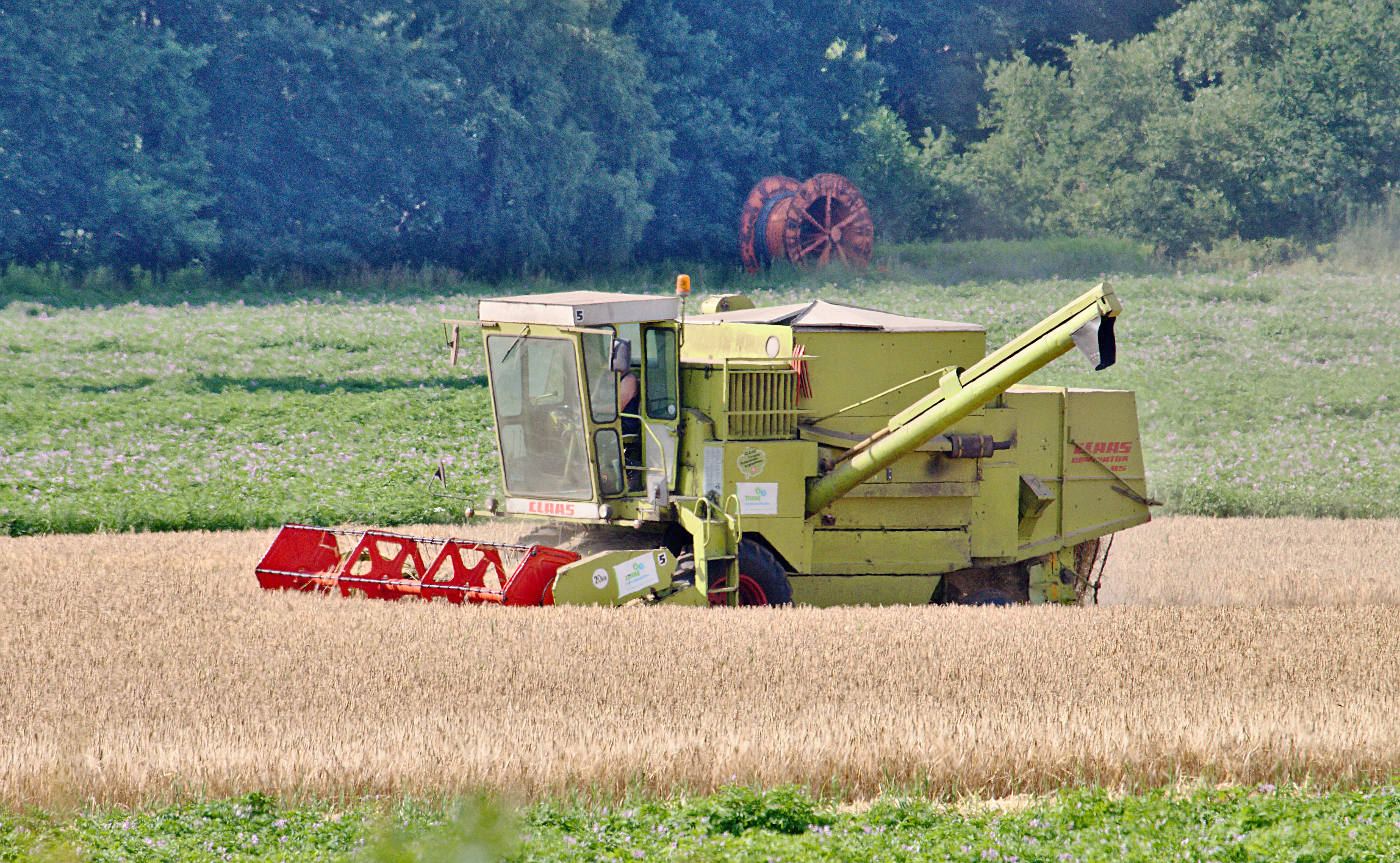
Both crops are harvested with conventional combine harvesters fitted with wide cutting headers. On large Brandenburg and Mecklenburg-Vorpommern farms, it is common to see multiple machines working in convoy across single fields of several hundred hectares.
July – August: Winter Wheat & Rye Summer
Winter wheat is Germany's most widely grown arable crop and the centre of the grain harvest season. The window typically runs from mid-July in Baden-Württemberg and Bavaria to late August in Schleswig-Holstein. Rye, more tolerant of sandy soils, is particularly important in Brandenburg and on the North German Plain.
Grain harvest timing depends heavily on weather. A wet July can push the combine season two to three weeks later, compressing the window significantly. Farmers monitor grain moisture content daily — wheat is typically cut at 13–15% moisture for safe storage.
Germany's wheat harvest volume is tracked annually by Destatis (the Federal Statistical Office). Published data for recent years are available at destatis.de.
August – September: Maize, Sunflowers & Early Potatoes Summer
Silage maize — grown for biogas and cattle feed rather than grain — is harvested from late August using forage harvesters. Grain maize follows in September to October. Maize has expanded significantly across Germany since the 2000s, partly driven by the Erneuerbare-Energien-Gesetz (Renewable Energy Act) subsidies for biogas plants.
Early potato varieties come off fields in August; main-crop potatoes follow through September and October. Potato harvesting uses multi-row harvesting machines that lift the tubers from the ridges, separate soil and haulms on a shaking web, and deliver clean tubers to a following trailer.
September – October: Wine Grapes Autumn
Germany's wine harvest — the Weinlese or Herbst — runs through September and October in the main growing regions: Rheingau, Mosel, Rheinhessen, Pfalz (Palatinate), Baden, and Württemberg. The timing varies by variety and appellation. Riesling, Germany's flagship variety, is often harvested late — sometimes into November for Spätlese and Auslese designations — when the grapes have concentrated sugars.
Most German wine estates combine mechanical harvesting for volume production with hand-picking for premium quality designations. Steep Mosel slate slopes cannot be mechanised and require hand picking throughout.
October – November: Sugar Beet & Late Potatoes Autumn
Sugar beet harvest is a major autumn event across Lower Saxony, Saxony-Anhalt, and North Rhine-Westphalia. Six-row sugar beet harvesters work through October and into November, with processing campaigns running at sugar factories (Südzucker, Nordzucker) typically from late September through January. Beet is stored in large outdoor clamps close to fields before haulage to the factory.
Late-season potatoes, including those grown for starch and seed, are lifted through October. Cold weather sets the upper limit — ground frost makes harvesting difficult and can damage tubers.
Summary Harvest Calendar
| Months | Crop | Main Regions |
|---|---|---|
| Mar – Jun | White asparagus | Lower Saxony, Palatinate, Baden-Württemberg |
| May – Jul | Strawberries | NRW, Rhine-Neckar, Bavaria |
| Jun – Jul | Winter barley, oilseed rape | Nationwide; south first |
| Jul – Aug | Winter wheat, rye | Nationwide; Brandenburg, NI, MV |
| Aug – Sep | Silage maize, early potatoes | Nationwide; Bavaria, Lower Saxony |
| Aug – Oct | Apples, pears, stone fruit | Altes Land, Lake Constance, Saxony |
| Sep – Oct | Wine grapes | Mosel, Rheingau, Pfalz, Baden |
| Sep – Nov | Grain maize, main-crop potatoes | Nationwide |
| Oct – Nov | Sugar beet | Lower Saxony, Saxony-Anhalt, NRW |
Regional Variations Worth Noting
The Lake Constance area (Bodensee) in Baden-Württemberg is Germany's most intensively cultivated fruit-growing zone, with apples, pears, and cherries harvested from late July through October. The Altes Land west of Hamburg — Germany's largest connected fruit-growing area — concentrates primarily on apples, with harvest running through September and October.
Hops, grown almost exclusively in Bavaria's Hallertau, Spalt, and Tettnang regions, are harvested during a narrow window in early September. The Hallertau accounts for roughly one third of global hop production. Harvest here involves mechanical picking machines positioned in the fields to which the bines are brought for stripping.
Carrot and onion harvest runs from August through October across the sandy soils of Lower Saxony and parts of Rhineland-Palatinate. These crops are largely mechanised and stored for winter distribution.
Data Sources
Harvest area and yield statistics for Germany are published by Destatis in the series Ernte- und Betriebsberichterstattung (Crop and Farm Reporting), available at destatis.de. The Federal Ministry of Food and Agriculture (BMEL) publishes an annual agricultural report (Agrarbericht) with yield forecasts and final harvest figures at bmel.de. The AMI (Agrarmarkt Informations-Gesellschaft) tracks wholesale price data and seasonal supply patterns for fresh produce at ami-informiert.de.